Thursday, March 7, 2024

"The Front Page"

Let's Take a Look at "The Front Page" 
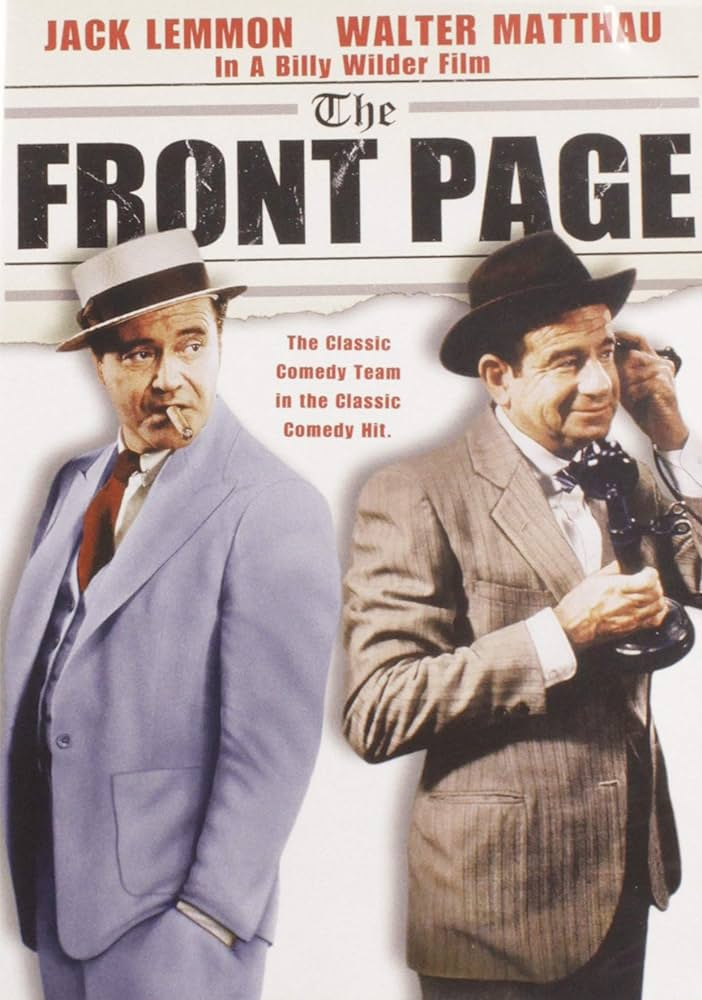
Anything and everything that involves journalism and writing, is an absolute amazement to me. This movie is great insight into the world of journalism and how it has shifted through the generations.

Being set in 1924, this film really captures what the life of a journalist is like. Any professional that I have talked to say that the people that are the most committed to their jobs, get very wrapped up in it. They eat, sleep and breathe journalism.

The first thing that I learned when deciding to become a Journalism major is that news is a 24/7 thing. It does not matter if it is 1 p.m. or if it is 3 a.m., someone has to write the story. This can really be seen in "The Front Page" because of the urgency behind writing that story.

News outlets want to be the first covering a story. All media competes with each other to be the first to report important details and developments. It is a constant battle for newspaper circulation and broadcast ratings. 

"The Front Page" demonstrates that race to be first, and while their actions and emotions may have been a little dramatized, I would say that that is how all journalists feel. Of course, in modern day it is a lot easier to access information because of technology, so there may not be as much of an anxiety-ridden rush. 

I think that it is very addicting when you are in the fast-pace nature of journalism. Hildy Johnson wanting to hang up his hat and retire from reporting, was not very surprising. It is a very time-consuming and stressful job, so it is reasonable to want to go on a different path.

Although, Hildy was very determined to marry Peggy Grant and start a new life, I had a feeling from the beginning that he would not be able to stop himself. For me, even writing for The View Point is such a rush because it is a great experience getting to cover that information and see your name on an article.  

It also was not surprising that Walter Burns was determined to keep Hildy in the game. The way that Walter was acting was very harsh and he went to some extreme measures, but I think that was a good representation of how any editor would act when they are losing their best reporter. However, he did cross the line by trying to mess with Hildy's personal life. 

Reporting and getting the news out there is of utmost importance. But nowadays, there is no way that an editor would be able to act like Walter and get away with it. Our modern society is much stricter and it would be likely that someone in Hildy's position would seek out ways of punishment for Walter's actions. 

Although, it was inspiring to see how committed they were to their jobs and to getting the story. In the field of journalism, it is very important to have a love for current news, fast-paced work, and writing. The way that Hildy could not turn down writing that one last story, really shows what true commitment is. 

Many journalists do get into that frenzy and when you have such good information on developments in a story. It is very easy to write a story when the information is continuously flowing in. Hildy wasn't just getting himself into that trance though, Walter was feeding the fire and urging him to get in that mode. 

The way Walter was urging him is definitely not out dated. Outside influences always affect how we operate and the decisions that we make. This is something that not only happens in the journalism world, but everyday life.  

This movie definitely depicted journalists' actions on the most extreme level, but it did not strike me as old-timey or outdated. It depends on the person as to how seriously they take reporting. Most reporters are always going to have that fire under them when they discover important information, it just matters how they choose to act on it. 

It was also interesting to see how all the characters interacted with each other throughout the movie. The scene that stood out to me the most, and reminded me of modern day, is when the sheriff was complaining that Hildy and Walter only write bad things about him, but they said it is just the truth. 

While some things they write may be misconstrued and a little false, that is what people don't understand nowadays. Journalists are supposed to write the truth. All of the good, the bad and the ugly. Many people get upset when they see controversial topics in the news but it is simply the journalists doing their job.   

Overall, I would say that"The Front Page" was a good example of what journalists feel and how they act. While a lot of it was most likely exaggerated for entertainment purposes, they were on track with the way journalism works. I feel that while I was entertained, I also learned a lot from this movie. 

Wednesday, February 14, 2024

EOTO #1: William Lloyd Garrison's - The Liberator

William Lloyd Garrison & The Liberator

William Lloyd Garrison, American abolitionist, journalist and social reformer, was born Dec. 10, 1805 in Newburyport, Massachusetts. Garrison grew up in the declining atmosphere of New England federalism and lively Christian benevolence-both the fuel of the abolition movement. 

He was said to be decades ahead of most northern white abolitionists in demanding the immediate emancipation of all people held in bondage. Once Garrison joined the movement at age 25, he was determined to restore the natural rights of enslaved persons. He helped lead the successful abolitionist campaign against slavery would later be known as the most aggressive and outspoken abolitionist. 

At the young age of 13, he apprenticed to a printer and newspaper publisher. Garrison really started his career in 1828 as an editor of the National Philanthropist in Boston. He then moved to the Journal of the Times in Vermont from 1828-1829. In 1829, Garrison meets antislavery advocate, Benjamin Lundy, and he moves to Baltimore to help publish Lundy's paper the Genius of Universal Emancipation

He began giving speeches and strongly denounced the national sin of slavery. Garrison also served a short term in jail for libeling a merchant who was involved in the coastal slave trade. When he was released from jail, Garrison returned to Boston and began publishing The Liberator

Jan. 1, 1831 marks the release of the first issue. The Liberator was a weekly newspaper that Garrison wrote and published for 35 years; he never missed a week. It was the most influential antislavery periodical in the pre-Civil War period. 

In the articles, he denounced all people and acts that would prolong slavery, including the U.S. Constitution. The paper's purpose was to attack slavery and its supporters, inspire action and promote equal rights for all. While calling for an immediate end to slavery, the Church was also attacked for being a tool to oppression. 

Garrison received many threats and attempts against his life because of his harsh criticisms of all people and institutions he saw as responsible for slavery. The Liberator was published in Boston but reached a much wider audience.

The strongest supporters of The Liberator were from the local Black community. Including leaders such as Reverend Thomas Paul and businessman James Barbadoes. They publicly endorsed the paper and roughly 75% of the subscribers helped financially support it. The Liberator gave a lot of insight into the Black community. People would report on meetings and gatherings at places such as the African Meeting House

The paper also served as an important part of the Boston's Underground Railroad network. There were reports of fugitive slave cases and assistance organizations. The office of The Liberator was used for donations, clothing, job opportunities and information. Freedom seekers looking for shelter were given refuge in the office as well.  


Garrison also used his paper to advocate for other social reform movements such as women's rights, pacifism, and capital punishment. He often included writings from people that disagreed with him which gave him a starting place for his sharp responses. 

"I do not wish to think, or speak, or write, with moderation...I am in earnest-I will not equivocate-I will not excuse-I will not retreat a single inch-AND I WILL BE HEARD," Garrison said in his first issue of The Liberator. Garrison was determined for the nation to hear his words and he was relentless in his fight to end slavery.

Garrison received recognition as the most radical of American antislavery advocates. He founded the New England Anti-Slavery Society that called for the immediate end of slavery. He then went on to help found the American Anti-Slavery Society

The societies held meetings, adopted resolutions, signed slavery petitions to be sent to Congress, published journals, etc. With this, Garrison's opposition to slavery and the federal government begins to reach its peak. The decade before the Civil War, Garrison also used The Liberator to denounce the Compromise of 1850, condemn the Kansas-Nebraska Act, damn the Dred Scott decision, and hailed John Brown's Harpers Ferry Raid as "God's method of dealing retribution upon the head of the tyrant." In 1854, Garrison publicly burned a copy of the Constitution at an abolitionist rally in Framingham, MA. 

After the Civil War, Garrison was forced to choose between his pacifist beliefs and emancipation. He put fighting for enslaved persons freedom first and supported Abraham Lincoln. In 1863, he welcomed the Emancipation Proclamation and in 1865 he attempted to dissolve the American Anti-Slavery Society, did not succeed and then retired.

"My vocation as an abolitionist has ended."   

The Liberator completed its run in Dec. 1865 when the 13th Amendment was ratified, which abolished slavery in the United States. In the final issue, Garrison stated, the Liberator "will then be discontinued for the reason that the object for which it was started has been accomplished-slavery not only having been abolished by the war for the Union, but also by Constitutional Amendment. What a grand and sublime triumph!"

Garrison spent the last 14 years retired from public affairs, but continued to support women's rights, pacifism and free trade.  

William Lloyd Garrison died on May 24, 1879. Garrison spent his life disturbing the peace of the nation in the cause of justice.   

Tuesday, February 6, 2024

Why Am I Here?

Why Journalism?

Surprisingly, I came into college with the hopes of becoming a Neurosurgeon. After watching Greys Anatomy my whole life, it just made sense. Neurosurgeon was it; the only plan that I had. There was no option of a plan B, because I was going to love it. 

The first week, I was hopeful and couldn't wait to get started. I made it through about the first month of classes and then realized I wanted nothing to do with the sciences. At this point, it was too late to switch classes, so I decided to give it more of a shot. I got to the end of the semester and there was no way I was going to do that again. 

Distraught, defeated, and lost was not enough to explain how I felt. It was definite that I needed to switch my major but I really struggled with what it was I wanted to do with my life. I explained everything I liked and was good at, and my success coach mentioned going into Strategic Communication, since it is such a broad field. 

So, I started my second semester as a Strat Comm major. It was such a change from Chemistry and Biology, I was almost bored to be honest. I went from having tons of homework and studying to do, to almost nothing. The work was very simple and easy to complete. 

At this point, I wasn't involved in too many extracurriculars because I was still trying to figure out what being in college really meant. So all that I had was classes. I would wake up, go to class, get my work done, and repeat. It was this endless cycle of being bored. 

With being bored, I started to overthink a lot and this led me down a very dark path. Switching my major sent me into a spiral; a fast, downhill spiral that seemed never-ending. I am someone who has never liked change and this was really testing me. 

I began to retreat into myself, questioning every decision I have ever made, while also telling myself I was a failure. Of course, this turned into a huge problem. I wasn't happy with myself and I wasn't happy with my new major. 

I got a very big wake-up call around this time last year. I had went home and ended up staying for almost a month because I felt so lost being here in High Point. There were many difficult discussions with my parents and discussions I needed to have with myself. 

I finally had the realization that I was putting too much pressure on myself and thinking too deeply into something as simple as a major. After being home for that amount of time, I knew I needed to come back to HPU. I needed to give myself grace and the time to figure out things, because in time everything ends up as it should be.  

When I got back to High Point, I finally worked up the courage to switch my major one last time. I knew I wanted to do it from the start but I let other's opinions get into my head. 

My cousin had told me that Journalism is a dying field and that I would make no money. As an 18 year-old freshman in college, hearing the words, "you aren't going to make any money," was enough to drive me crazy. But one day I woke up and I thought why would I sell myself short, and not even give it a shot? 

That day I stopped listening to other's opinions on my life and I decided to do what was going to be best for me. I emailed my advisor, we discussed it, she told me I was making the right decision and she couldn't wait to see all that I was going to do. I signed the papers and in the High Point University system about a day later, I was officially a Journalism major with a minor in Political Science.  

My story on how I got here is quite complex and is not always the most positive, but I'm thankful for every minute of my journey. Going through those really tough times of trying to figure out who I am and what I wanted out of life, shaped me into the young adult I am today. Being able to really question everything has made me feel very grounded in the path that I am now on. 

I needed to be unsure, and feel lost so I could find what I really wanted to do. After going through so many months of questioning and being distraught, I am very confident as a Journalism major. I know this was the right choice because as soon as I signed the paper to make Journalism my major, I felt a weight lift off my shoulders. I finally found what I was meant to do.

Writing has been a passion of mine since the day I learned to write the alphabet. The first core memory of when I realized I really enjoyed writing, was when my third grade English teacher told me that I was a fantastic writer and that I need to continue writing, no matter what. 

Looking back now as a sophomore in college, there is no way a third grader was really that good at writing. But that encouragement at such a young age has really fueled my love for writing. Having the opportunity to take writing-based classes has been such a privilege and an amazing experience. 

Classes such as Media Law & Literacy, have allowed me to better my writing while also learning about something that I am very interested in. This has led me to Never Stay Silent. I absolutely loved the set up of Media Law & Literacy and how writing-intensive it was. When I saw that I would be able to take another class with Professor Smith, I jumped at the opportunity. 

Being an aspiring Journalist who loves writing and discussing politics/current events, Never Stay Silent was a no-brainer to add to my second semester schedule. While I am a very strong creative writer, my goal is to write for a major news network one day. After learning journalistic style writing and how to actually write about news and events these last two semesters, I know this is where I'm supposed to be.  

The support from my friends and family got me through a very difficult Freshman year, and I am very proud to say that I have grown immensely. I can't wait to see all that this semester brings and how I grow as a Journalism major and writer. I'm very happy to be here!